
Most businesses will work with multiple digital agencies before finding the right fit. That is a very expensive education. The true cost is not just your monthly retainer fee. It is the months of lost momentum, the broken website code, and the trust damage that makes you hesitate to invest again.
Knowing how to spot web agency red flags early can save your business thousands of dollars. A decade ago, bad agencies were easy to spot. Today, low-quality firms have learned how to sound incredibly sophisticated.
They use complex jargon to hide their lack of strategy. They promise massive results while keeping their actual methods a secret. In this guide, we are pulling back the curtain to reveal the absolute worst warning signs in the digital marketing industry.
Why Spotting Web Agency Red Flags Early Saves Your Business
Hiring a web development or SEO agency is exactly like taking on a new business partner. You are trusting them with your brand reputation and your revenue pipeline. When that partnership fails, the fallout affects your entire company.

A bad agency does not just waste your marketing budget. They can actively harm your domain authority through spammy link-building tactics. They might build a website architecture so flawed that Google simply refuses to index your pages.
By the time you realize you made a mistake, you are usually locked into a 12-month contract. Learning to identify these warning signs during the sales pitch is your best defense. If a prospective partner triggers even one of the warnings below, walk away immediately.
10 Critical Web Agency Red Flags You Must Watch Out For
1. They Guarantee “Number 1” Google Rankings Overnight
Nobody can guarantee a number one ranking on Google. The search engine uses thousands of dynamic ranking factors that change constantly. Google explicitly warns businesses to avoid SEO companies that claim to guarantee rankings.
The Trap:
They promise to get you to the top of the first page within 30 days. They assure you that their “proprietary secret method” beats the algorithm every time.
The Reality:
To achieve fast results, these agencies use toxic, black-hat SEO tactics. They buy spammy backlinks or duplicate content. You might see a temporary spike in traffic, but your website will eventually receive a manual penalty from Google.
2. Refusing to Share Ownership of Your Data and Assets
Your digital assets belong to your business. This includes your domain name, website hosting, Google Analytics 4, and Google Search Console. One of the most dangerous web agency red flags is a company that registers these assets under their own name.
The Trap:
They tell you not to worry about the technical details. They offer to buy the domain and set up hosting on their private server to “save you time.”
The Reality:
They are holding your business hostage. Imagine wanting to fire your agency, only to discover they legally own your website domain. They will often demand an exorbitant “release fee” to transfer your own assets back to you. Always demand administrative access to everything.
3. Vague Pricing and Hidden Costs
Transparency is the foundation of any healthy business relationship. You deserve to know exactly where every dollar of your budget is going. If an agency cannot explain their pricing model clearly, they are hiding something.
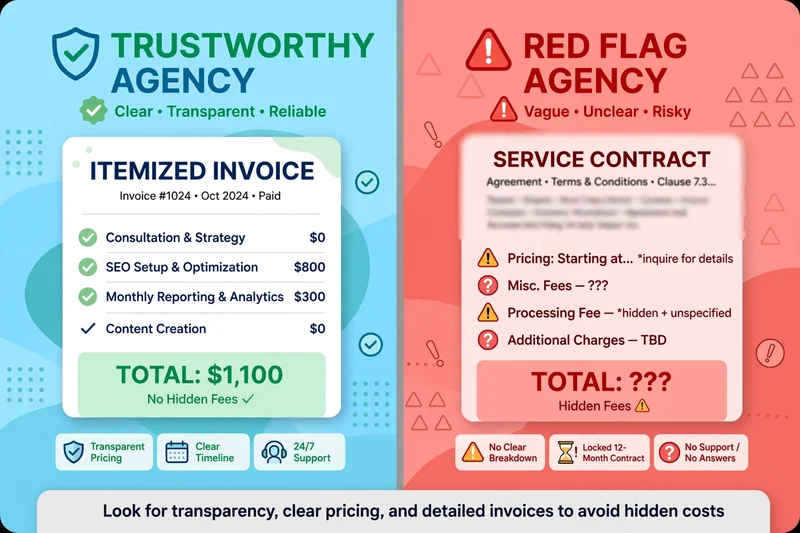
The Trap:
They send a proposal with a single, massive price tag at the bottom. There is no itemized breakdown of deliverables, hours, or software costs.
The Reality:
Agencies with vague pricing often overcharge for services you do not need. They might secretly charge you for expensive third-party tools while actually using free alternatives. You will also likely face sudden “out of scope” fees halfway through the project.
4. The Classic “Bait-and-Switch” Team Strategy
Who you talk to during the sales pitch is rarely who actually works on your account. This bait-and-switch tactic is incredibly common in large, corporate marketing agencies.
The Trap:
A charismatic senior executive pitches your business. They demonstrate deep industry knowledge and present a brilliant strategy. You sign the contract believing this expert will manage your account.
The Reality:
The moment the ink dries, the senior executive disappears. Your account is handed off to an unpaid intern or a junior employee who started three weeks ago. Worse, the agency might silently outsource your entire project to a cheap overseas provider without telling you.
5. Ignoring Technical SEO During the Build
A beautiful website is entirely useless if search engines cannot read it. Design and performance must happen simultaneously. If an agency only wants to talk about colors and fonts, run away.
The Trap:
They show you stunning visual mockups. However, they brush off your questions about page speed, mobile responsiveness, and site architecture.
The Reality:
They build a heavy, bloated website that takes ten seconds to load. You can review our technical SEO audit checklist to see everything they ignored. You will eventually have to hire a second agency just to fix the foundational coding errors of the first one.
6. Selling One-Size-Fits-All Template Packages
Your business is unique, and your digital strategy should reflect that. An agency that forces every client into the exact same rigid package is prioritizing their profit over your success.
The Trap:
They offer three rigid pricing tiers: Bronze, Silver, and Gold. They try to squeeze your complex business requirements into their pre-built Silver package without asking any discovery questions.
The Reality:
They are likely selling you a $50 website template marked up to $5,000. If you are paying premium rates for custom web development services, you deserve bespoke code tailored to your exact business goals. Cookie-cutter strategies yield cookie-cutter results.
7. Vanity Metric Reporting Instead of ROI
Good marketing generates revenue. Bad marketing generates meaningless charts that look impressive but do nothing for your bank account.
The Trap:
They send you a monthly report celebrating a 500% increase in “impressions.” They boast about ranking number one for a keyword that gets zero searches per month.
The Reality:
They are hiding behind vanity metrics because they are failing to generate actual leads or sales. Impressions do not pay your payroll. A trustworthy agency reports on meaningful key performance indicators (KPIs) like qualified leads, conversion rates, and total return on investment.
8. No Verifiable Portfolio or Case Studies
A reputable agency is proud of their work. They want to show it off and explain how they achieved success for their clients.
The Trap:
Their website features generic stock photos instead of real client work. When you ask for case studies, they claim their work is “confidential” due to strict non-disclosure agreements.
The Reality:
They either have zero experience or a long list of failed projects. Never trust screenshots alone. Ask for the URLs of live websites they built, test those sites for speed, and request permission to contact their past clients directly.
9. The Most Dangerous Technical Web Agency Red Flags: Fake AI Expertise
In 2026, AI Search and Generative Engine Optimization (GEO) are dominating the internet. Many old-school SEO agencies are panicking and falsely claiming AI expertise to stay relevant.
The Trap:
They slap “AI SEO Experts” on their homepage. They promise to optimize your content for Google AI Overviews and ChatGPT search.
The Reality:
They have no idea how AI search actually works. Ask them to explain their Answer Engine Optimization (AEO) methodology. If they stare at you blankly or give a vague answer, they are lying about their capabilities.
10. Poor Communication During the Sales Process
The sales phase is when an agency is on their absolute best behavior. If they are difficult to reach before you give them money, it will only get worse afterward.
The Trap:
They take four days to reply to a simple email. They show up late to your Zoom meetings. Their initial proposals contain typos and formatting errors.
The Reality:
If they cannot manage their own sales pipeline, they cannot manage your digital marketing campaigns. Disorganization is one of the most glaring web agency red flags. You need a partner who values your time and communicates proactively.
How Web Vision Expert Does Things Differently
Finding a reliable partner does not have to be a nightmare. This is exactly why businesses seek out the best SEO services in Pakistan—to find a team that values true transparency.
At Web Vision Expert, we operate entirely in-house. We do not outsource your success to anonymous offshore freelancers. Our pricing is completely transparent, our case studies are verifiable, and you retain 100% ownership of every digital asset we build. We believe that an educated client is our best partner, which is why we explain the “why” behind every line of code and every SEO strategy we deploy.
Web Agency Red Flags: A Quick Comparison Table
| Agency Behavior | Red Flag Agency 🚩 | Trustworthy Agency ✅ |
| Asset Ownership | Registers domain in their name. | You own your domain, hosting, and data. |
| Pricing | Hidden fees and vague bulk pricing. | Itemized, transparent pricing structure. |
| Rankings | Guarantees #1 ranking in 30 days. | Promises ethical growth and sets realistic timelines. |
| Team | Pitched by CEO, handled by intern. | You meet the actual developers and strategists. |
| Reporting | Focuses on raw impressions and vanity metrics. | Focuses on leads, revenue, and ROI. |
The Ultimate Agency Vetting Checklist
Use this quick checklist during your next discovery call. If the agency fails these tests, consider it a massive warning sign.
- Do they ask about your specific business goals before pitching a price?
- Will they provide a list of past clients you can contact directly?
- Do they confirm in writing that you own all administrative rights?
- Can they explain their link-building strategy without using vague buzzwords?
- Do they conduct a technical audit before starting a new SEO campaign?
Frequently Asked Questions (FAQs)
What are common website red flags?
Common website red flags include incredibly slow loading speeds, broken links, non-responsive mobile designs, and generic stock imagery. If an agency delivers a site lacking basic SSL security or proper heading structures, it proves they ignore fundamental technical standards.
How do I know if a company is a red flag?
You know a company is a red flag if they refuse to show a verifiable portfolio or hide their actual pricing. Poor communication, guaranteed instant results, and high-pressure sales tactics are also major indicators that the agency lacks integrity and skill.
What questions should I ask to spot a dishonest web agency?
Always ask who exactly will be executing the daily work on your account. Ask them to explain their strategy for dealing with algorithm updates. Finally, ask what happens to your website and data if you decide to cancel your contract with them.
How do you find out if a company has a bad reputation?
Search their agency name along with words like “reviews” or “complaints” on Google. Check third-party review platforms, look at employee turnover rates on LinkedIn, and directly message their past clients to ask about their real experiences.
What are the signs of a bad SEO company?
A bad SEO company will promise guaranteed number one rankings and hide their link-building methods. They usually provide automated reports focusing strictly on vanity metrics while completely ignoring your actual business leads, sales, and total revenue growth.
Final Thoughts on Hiring the Right Partner
Choosing the right digital partner requires patience and strict due diligence. Do not let flashy presentations blind you to the underlying reality of how an agency operates.
By paying attention to these web agency red flags, you protect your brand from costly, irreversible mistakes. Demand transparency, insist on owning your own data, and only sign a contract when you feel absolute confidence in the team sitting across from you. Your business deserves nothing less than a completely honest, highly skilled partnership.