Understanding the 4 types of SEO On-Page, Off-Page, Technical, and Local—is essential for any business aiming to capture top rankings on Google and modern AI search engines. Every search engine optimization campaign relies on these foundational pillars to build domain authority, improve site crawlability, and convert organic traffic into revenue.
While search algorithms evolve continuously, the underlying framework remains consistent. Focusing on just one area leaves your website vulnerable to competitors who execute a complete search strategy.
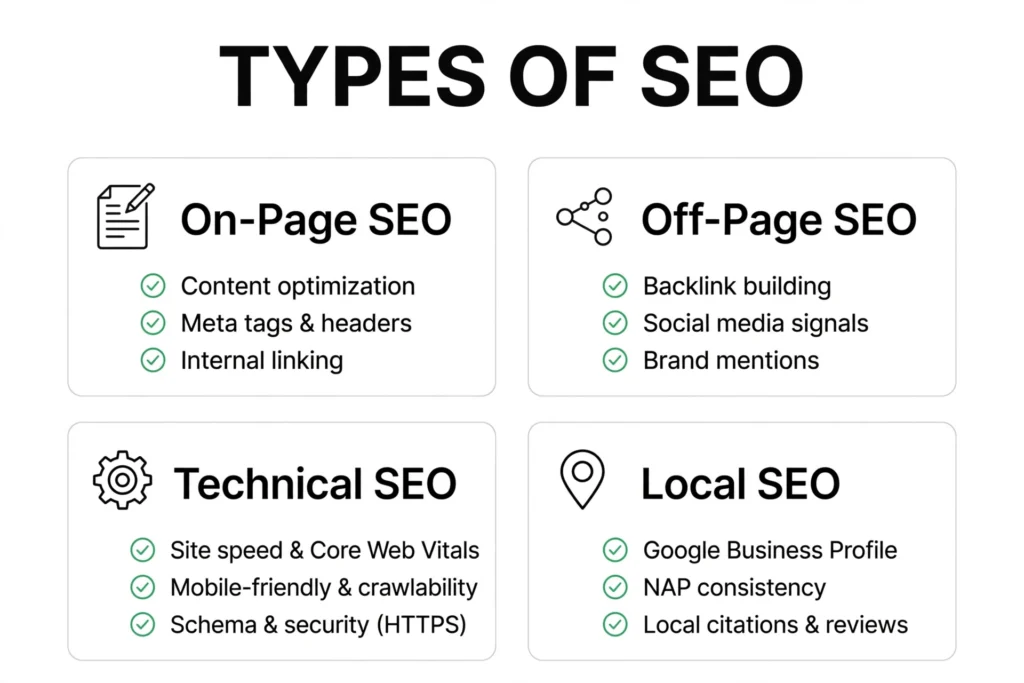
Breakdown of the 4 Types of SEO
A successful organic marketing strategy balances content quality, technical site health, external trust signals, and geographic relevance. Here is how each individual pillar contributes to your site’s overall search performance.
1. On-Page SEO: Content and Intent Optimization
On-Page SEO involves optimizing all visible elements directly on your website to help search engines understand your content context and relevance.
- Keyword Placement: Place target terms in your page titles, headers, first 100 words, body text, and meta descriptions without over-stuffing.
- Search Intent Alignment: Match content structure to user expectations, whether they seek quick informational answers or commercial comparisons.
- Internal Linking: Connect related blog posts and landing pages using descriptive anchor text to distribute page authority effectively.
- Visual Asset Optimization: Compress images, write descriptive alt text, and use modern formats like WebP to speed up page load times.
Businesses seeking custom content audits often utilize dedicated on-page SEO services to streamline semantic optimization across their landing pages.
2. Off-Page SEO: Authority and Backlink Building
Off-Page SEO covers actions taken outside your website to build brand authority, trust, and domain reputation across the broader web ecosystem.
- Editorial Backlinks: Earn high-quality inbound links from authoritative websites within your industry niche.
- Digital PR & Outreach: Secure media coverage, brand mentions, and thought-leadership placements on external publications.
- Social Signals & Distribution: Share content across social networks to drive direct referral traffic and increase brand queries.
- Unlinked Brand Mentions: Identify online references to your business and request active hyperlinks from webmasters.
Investing in ethical off-page SEO services ensures your link profile grows naturally without triggering search engine spam penalties.
3. Technical SEO: Performance and Crawlable Architecture
Technical SEO establishes the underlying infrastructure required for search engines to efficiently crawl, render, and index your website pages.
- Site Speed & Core Web Vitals: Optimize Largest Contentful Paint (LCP), Interaction to Next Paint (INP), and Cumulative Layout Shift (CLS) scores.
- Mobile Responsiveness: Ensure seamless rendering, legible fonts, and responsive layouts across mobile smartphones and tablets.
- XML Sitemaps & Robots.txt: Guide search engine crawlers toward important content while blocking duplicate or low-value URL structures.
- Structured Data & Schema: Implement Schema.org code blocks to help Google generate rich snippets and AI answer summaries.
Brands experiencing indexation issues or site speed bottlenecks rely on specialized technical SEO services to fix backend coding errors.
4. Local SEO: Geographic and Business Visibility
Local SEO targets location-specific search queries to help brick-and-mortar stores and service area businesses capture nearby prospective customers.
- Google Business Profile (GBP): Claim, verify, and fully optimize your business listing with accurate categories, hours, and photos.
- NAP Consistency: Maintain consistent Name, Address, and Phone number details across all local directories and citation platforms.
- Local Customer Reviews: Collect and respond to authentic customer reviews on Google, Yelp, and industry-specific review sites.
- Localized Landing Pages: Create dedicated pages for each target city or neighborhood containing local schema markup.
Comparison Table: Evaluating the 4 Types of SEO
| SEO Type | Primary Focus | Key Optimization Tactics | Typical Impact Horizon | Business Priority Level |
| On-Page SEO | Content & User Intent | Keyword placement, headings, internal links, image alt text | 30 to 90 Days | High (Immediate Requirement) |
| Off-Page SEO | Brand Authority & Trust | Guest editorial outreach, backlink audits, digital PR campaigns | 90 to 180 Days | High (Ongoing Strategy) |
| Technical SEO | Site Health & Architecture | Core Web Vitals, Schema markup, crawl error fixes, JS rendering | 14 to 60 Days | Critical (Foundational Step) |
| Local SEO | Regional & Map Visibility | Google Business Profile, local citations, NAP alignment, reviews | 30 to 60 Days | High (For Local Businesses) |
How the 4 Types of SEO Work Together for Maximum ROI
Treating these four disciplines as isolated silos leads to sluggish organic growth. Technical SEO ensures search engines access your site, On-Page SEO presents relevant answers, Off-Page SEO establishes industry trust, and Local SEO captures geographically targeted demand.
┌─────────────────────────────────────────────────────────────────┐
│                     TOTAL SEARCH VISIBILITY                     │
└─────────────────────────────────────────────────────────────────┘
                                 │
     ┌───────────────────────────┼───────────────────────────┐
     ▼                           ▼                           ▼
┌──────────────┐          ┌──────────────┐          ┌──────────────┐
│  Technical   │ ───────► │   On-Page    │ ───────► │   Off-Page   │
│ Foundation   │          │ Content Hub  │          │ Backlinks    │
└──────────────┘          └──────────────┘          └──────────────┘
                                 │
                                 ▼
                          ┌──────────────┐
                          │  Local Maps  │
                          │  Geographic  │
                          └──────────────┘
Why Master All 4 Types of SEO in 2026?
With the rise of Google AI Overviews, ChatGPT Search, and voice-assisted devices, search engines analyze domain authority holistically. A site with rapid page speeds will still struggle to rank if its content lacks comprehensive topic coverage or backlink signals.
Implementation Checklist: Executing Each SEO Pillar
1.Execute a Technical SEO Audit:Establish site infrastructure.
Fix broken links, resolve 404 crawl errors, implement XML sitemaps, and optimize server response times to guarantee indexability.
2.Optimize On-Page Elements:Content alignment and keyword mapping.
Update target page titles, build structured header hierarchies (H1, H2, H3), and insert schema markup to target featured snippets.
3.Build Local Citations and Google Business Profile:Capture geographic search demand.
Complete your Google Business Profile listing, verify NAP data across regional directories, and initiate a customer review strategy.
4.Launch Strategic Off-Page Campaigns:Establish external trust signals.
Conduct targeted link outreach, publish guest editorial articles, and claim unlinked brand references to build domain authority.
Emerging Trends: GEO and AEO Integration
Beyond the traditional four pillars, modern search strategies incorporate Generative Engine Optimization (GEO) and Answer Engine Optimization (AEO). These frameworks adapt content specifically for artificial intelligence models:
- Direct Answer Formatting: Structure key factual definitions into clear 40 to 60 word paragraphs directly below header tags.
- Entity Relationships: Connect related brand topics using precise Schema.org vocabulary so AI bots recognize your niche authority.
- Conversational Long-Tail Queries: Target natural spoken questions used in voice search queries across mobile and smart home devices.
Common Mistakes to Avoid Across All 4 Pillars
- Neglecting Mobile Performance: Optimizing only for desktop views causes ranking drops on mobile-first search indexing.
- Buying Spam Links: Purchasing automated backlink packages on private blog networks triggers severe Google manual action penalties.
- Ignoring Crawl Errors: Allowing site updates to break internal redirect chains wastes crawl budget and dilutes page authority.
- Duplicating Local Pages: Creating near-identical landing pages for dozens of cities without unique local details triggers low-quality content filters.
Frequently Asked Questions
What are the 4 main types of SEO?
The 4 main types of SEO are On-Page SEO, Off-Page SEO, Technical SEO, and Local SEO. On-Page focuses on content and keywords, Off-Page builds authority through backlinks, Technical optimizes site speed and architecture, and Local targets geographic search queries.
Which of the 4 types of SEO should I start with first?
Always start with Technical SEO to resolve crawl blocks, followed immediately by On-Page SEO to structure core content. Once your site infrastructure is fast and indexable, expand into Off-Page link building and Local SEO campaigns.
How does Local SEO differ from traditional On-Page SEO?
Local SEO optimizes your online presence for specific geographic locations using Google Business Profiles, localized map listings, and regional citations. On-Page SEO focuses broadly on keyword placement, content relevance, and technical HTML tags across individual site pages.
Is technical SEO more important than content optimization?
Neither is more important because both depend on each other. Technical SEO ensures search engine bots can access and index your site code, while content optimization gives users and search engines relevant information to rank.
Can I achieve top rankings using only On-Page SEO?
Ranking competitive keywords using only On-Page SEO is rare. Without Technical SEO your site may not load properly, and without Off-Page backlinks your domain will lack the authority needed to outrank established competitors.