

Selecting the best custom web development company determines whether your digital presence generates sustainable revenue or creates continuous technical debt. Businesses requiring bespoke web applications, high-converting e-commerce portals, or complex software architectures cannot rely on basic website builders. Understanding how to evaluate technical expertise, agency communication, and code quality empowers you to hire the right development partner confidently.

What Defines the Best Custom Web Development Company?
The best custom web development company builds tailored digital platforms engineered specifically around your business workflows and target audience. Unlike template-based setups, bespoke web development delivers specialized database schemas, modular front-end frameworks, and custom application programming interface integrations.
Top custom agencies align technical architecture with long-term business goals. They ensure your web platform scales effortlessly as server traffic and transaction volumes expand. Before commissioning any project, review what is custom web development to clarify scope parameters and technical requirements.
High-caliber web agencies also build search engine visibility directly into the underlying code. They construct clean Document Object Model structures, optimized database queries, and structured schema data. This technical foundation allows search engine crawlers and generative artificial intelligence systems to index and understand your content efficiently.
Core Benefits of Partnering with a Custom Web Agency
Investing in tailored web application engineering provides distinct operational and competitive advantages over pre-built themes. Off-the-shelf software often includes bloated code, unused scripts, and restrictive layouts that hinder site speed and user conversion rates.
- Unrestricted Scalability: Custom web architectures grow alongside your business without requiring costly complete rebuilds.
- Superior Site Performance: Tailored codebases eliminate unnecessary plugin dependencies, ensuring rapid load times and high Core Web Vitals scores.
- Enhanced Cyber Security: Bespoke backend code reduces vulnerability to automated mass exploits targeting popular pre-made plugins.
- Full Data Ownership: You retain complete control over your application database, proprietary algorithms, and customer interaction metrics.
Comparing bespoke engineering against theme implementation highlights clear performance differences. Evaluate custom website vs template website advantages to align your budget with long-term digital growth goals.
Essential Pillars of Technical Web Development
A reliable development agency maintains multi-disciplinary engineering standards across the entire software development lifecycle. Evaluating these foundational technical pillars prevents project delays and post-launch failures.
Technical Stack Flexibility (React, Next.js, Laravel, WordPress)
Modern web platforms demand specific technology combinations tailored to functional requirements. A competent custom agency does not force every project into a single framework.
For dynamic user interfaces and headless architectures, engineering teams utilize React or Next.js to deliver seamless single-page application experiences. Enterprise backend logic, complex relational databases, and secure administrative portals often rely on PHP frameworks like Laravel. For content-heavy portals requiring user-friendly publishing systems, customized headless WordPress setups offer flexibility and editor ease.
Code Ownership and Intellectual Property Rights for Best Custom Web Development Company Clients
Working with the best custom web development company guarantees that your business owns every line of custom source code upon final payment. Ambiguous contracts sometimes allow agencies to hold site repositories hostage or charge licensing fees for custom features.
Ensure your contract explicitly assigns full intellectual property rights, repository access, and database credentials to your entity. Reputable agencies deliver complete Git repository access along with comprehensive developer documentation.
AI Search Readiness (SEO, AEO, and GEO Capabilities)
Modern web development extends beyond traditional search engines to encompass Answer Engine Optimization and Generative Engine Optimization. Web applications must structure data cleanly so artificial intelligence agents like ChatGPT Search, Gemini, and Perplexity can parse site content accurately.
A forward-thinking development partner implements dynamic Schema markup, semantic Hypertext Markup Language headings, and server-side rendering. These structural details ensure search engines and artificial intelligence answer engines extract factual context without rendering friction.
Web Vision Expert Insight: A page or web application targeting modern artificial intelligence search systems must structure core answers directly before expanding into technical specifics. This explicit hierarchy helps search engine bots and AI language models categorize site content accurately.
Maintenance, Security, and Post-Launch Service Level Agreements
Websites require ongoing updates, security patches, performance monitoring, and server configuration adjustments after deployment. A single deployment without post-launch maintenance risks performance degradation over time.
Professional agencies provide structured Service Level Agreements that guarantee response times for critical bugs, downtime incidents, and security updates. Establish post-launch support protocols during initial contract discussions to protect your software investment.
How to Choose a Custom Web Development Company in 7 Steps
Selecting an agency partner requires a methodical vetting process rather than relying solely on promotional claims. Follow these seven practical steps to evaluate development teams effectively.
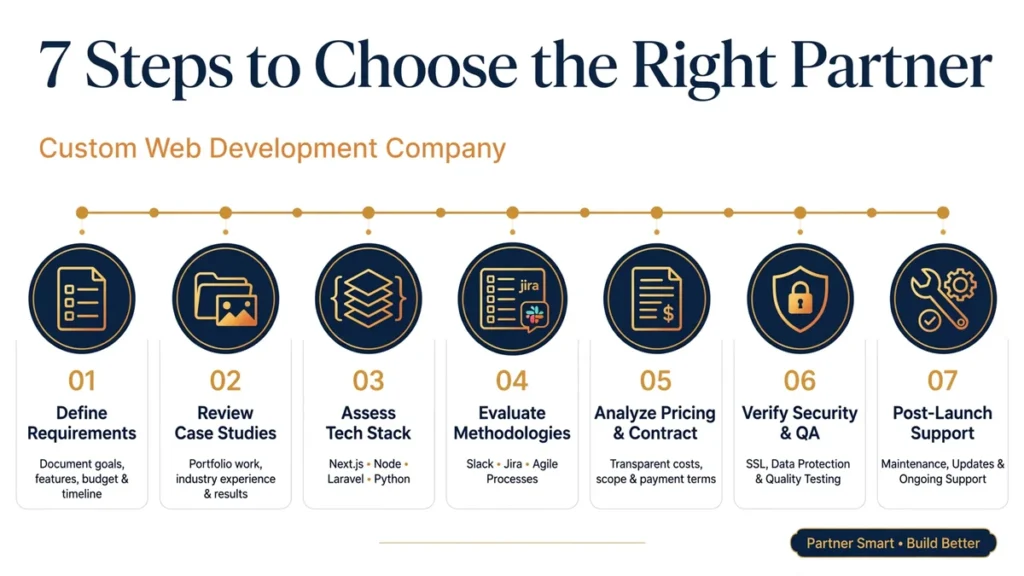
- Define Your Technical Requirements and Scope: Document your required functionality, third-party integrations, target audience, and expected server load before contacting agencies.
- Review Case Studies and Live Portfolio Projects: Inspect published client websites directly using developer tools to verify mobile responsiveness, code quality, and performance speed.
- Assess Engineering Stack Expertise: Verify whether the agency maintains hands-in-code experience with modern technologies relevant to your build, such as Next.js, Node.js, Laravel, or Python.
- Evaluate Development Methodologies and Communication: Inquire about their project management frameworks, sprint schedules, testing procedures, and communication channels like Slack or Jira.
- Analyze Pricing Models and Contract Transparency: Distinguish between Fixed-Price agreements and Time and Materials contracts while reviewing itemized cost breakdowns.
- Verify Security Protocols and Quality Assurance Standards: Confirm automated and manual testing routines, Secure Sockets Layer standards, input sanitization practices, and data backup policies.
- Inspect Post-Launch Support and Maintenance Options: Confirm that the development partner offers long-term maintenance, server management, and technical troubleshooting support.
Agencies like Web Vision Expert, a web development and SEO agency based in Karachi, Pakistan, serve clients across local and international markets in the United States, United Kingdom, and United Arab Emirates by combining technical web engineering with integrated search visibility strategies. Evaluating specialized custom web development services allows businesses to secure tailored web architecture alongside long-term optimization support.
Agency Comparison Matrix: Custom Development vs. Off-the-Shelf Agencies
Evaluating agency capabilities against project requirements helps identify the correct partner type for your business scale.
| Attribute | Freelance Developers | Offshore Template Agencies | Custom Web Development Agencies |
| Core Focus | Specific isolated tasks | Rapid theme customization | Bespoke application architecture |
| Code Quality | Variable quality | High code bloat | Clean, modular, optimized code |
| Scalability | Limited future expansion | Restricted by base theme | Enterprise-grade scalability |
| SEO & AEO Readiness | Basic on-page edits | Minimal semantic structure | Full technical, AEO, and GEO setup |
| Security Standards | Basic plugin reliance | High plugin vulnerability | Custom security, sanitization, & SLAs |
| Project Ownership | Individual dependent | Vendor-locked themes | 100% Client code & IP ownership |
Step-by-Step Vetting Framework for Hiring Web Developers
Follow this structured workflow during discovery calls to evaluate developer competency accurately.
[Phase 1: Initial Screening] ➔ Review live web applications & test performance metrics
[Phase 2: Discovery Call]     ➔ Discuss business objectives & evaluate technical communication
[Phase 3: Code & Architecture]➔ Review sample code repositories & database design strategy
[Phase 4: Proposal Evaluation]➔ Analyze technical scope, deliverables, and milestone schedules
[Phase 5: Contract & Legal]   ➔ Lock IP ownership, confidentiality NDAs, and SLA terms
Step 1: Conduct Live Performance and Security Audits
Request URLs of three recently completed custom web projects from the candidate agency. Run these pages through Google PageSpeed Insights and technical security scanners.
Examine desktop and mobile performance scores, Cumulative Layout Shift, and Largest Contentful Paint metrics. High performance scores reflect disciplined front-end engineering and clean server configuration.
Step 2: Interview the Actual Engineering Team
Ensure you speak directly with lead software engineers or technical project managers rather than sales representatives. Sales personnel often make unrealistic promises regarding timelines and technical feasibility.
Ask engineering leads how they handle database scaling, security sanitization, automated testing, and version control. Direct technical dialogues quickly expose gaps in agency capabilities.
Step 3: Examine Contractual Terms and Cost Structures
Examine the financial proposal to ensure every feature, design revision, and integration carries a clear cost allocation. Request details regarding potential scope changes and hourly rates for additional feature requests.
Understanding financial requirements early prevents unexpected expenses mid-project. Reviewing custom web development cost guidelines provides clear benchmarks for market pricing and resource allocation.
Checklist for Selecting Your Web Development Partner
Use this operational checklist during evaluation calls to score potential web development partners objectively.
- [ ] Portfolio Verification: Confirmed at least three live, high-traffic custom websites built by the agency.
- [ ] Technical Stack Alignment: Confirmed hands-on mastery of required languages and frameworks.
- [ ] Code Repository Access: Verified client receives full Git access and daily codebase commits.
- [ ] IP Ownership Clause: Contract explicitly grants 100% intellectual property rights upon completion.
- [ ] Search Engine Architecture: Agency integrates technical SEO, structured data, and rapid load speed natively.
- [ ] Security Protocols: Standardized implementation of data encryption, sanitization, and automated daily backups.
- [ ] Clear Milestone Schedule: Payment terms tied strictly to verified milestone completions and testing approvals.
- [ ] Post-Launch Maintenance SLA: Documented response guarantees for server maintenance and emergency fixes.
Expert Tips to Maximize ROI on Custom Web Development
Achieving maximum return on investment requires active client involvement and clear strategic direction throughout software creation.
Focus on building a Minimum Viable Product before introducing complex optional features. Launching core application functionality early allows real users to test your platform while reducing initial development expenses.
Prioritize API-first architectures during initial database design. Building modular Application Programming Interfaces allows your platform to connect effortlessly with external Customer Relationship Management tools, payment gateways, and mobile applications in future iterations.
Integrate technical search optimization and Answer Engine Optimization standards from day one. Retrofitting structural Schema markup or URL hierarchies onto a completed codebase increases engineering costs significantly.
Common Mistakes When Hiring a Custom Web Development Company
Avoiding frequent procurement missteps protects your organization from financial loss and project failure.
- Mistake: Choosing an agency based solely on the lowest price quote.
- Better approach: Evaluate proposals based on technical competency, scope depth, architectural quality, and long-term business value.
- Mistake: Neglecting to secure complete source code and database ownership rights in writing.
- Better approach: Ensure your contract explicitly states that all source code, design assets, and intellectual property belong exclusively to your company.
- Mistake: Hiring a team that relies heavily on third-party pre-built plugins for core application logic.
- Better approach: Insist on custom-engineered backend code for proprietary workflows to ensure site speed, stability, and cyber security.
- Mistake: Omitting post-launch server maintenance, bug fixing, and security updates from initial budget plans.
- Better approach: Require a comprehensive post-launch Service Level Agreement that outlines ongoing technical support and maintenance terms.
- Mistake: Failing to involve technical search engine optimization specialists during wireframing and site architecture planning.
- Better approach: Ensure your web development partner incorporates clean semantic HTML structure, Schema markup, and speed optimization during early build phases.
Frequently Asked Questions
What makes the best custom web development company different from a standard agency?
A custom web development agency engineers tailored software architectures, custom database schemas, and specialized user interfaces designed around specific business workflows. Standard agencies typically rely on pre-built templates and page builders, which restrict technical scalability, page speed, and application security.
How much does hiring a custom web development company cost?
Custom web development costs vary depending on application complexity, required API integrations, design uniqueness, and technical scope. Basic custom platforms typically start around several thousand dollars, while enterprise-grade web applications featuring custom backend infrastructure require higher capital investments.
How long does a custom web development project take to complete?
A bespoke web development project generally takes between 8 to 16 weeks from discovery to final deployment. Timeline length depends directly on project scope, design iteration speed, API integration complexity, quality assurance testing, and client feedback response times.
Will my custom website be optimized for mobile devices and search engines?
Yes, professional custom agencies build responsive layouts that adapt dynamically across all screen resolutions. Furthermore, clean source code, server-side rendering, and structured Schema markup ensure optimal indexing across traditional search engines and AI answer engines.
Do I own the source code after my custom website is launched?
You should retain 100% ownership of your custom source code, design assets, and intellectual property upon final payment. Always verify that your agency agreement explicitly includes full repository access and intellectual property assignment clauses.
Final Thoughts
Partnering with the best custom web development company transforms your digital platform into a high-performing business asset. By prioritizing technical stack flexibility, clean code architecture, code ownership, and search engine readiness, you secure a web foundation built for sustainable digital growth. Conduct thorough technical audits, verify portfolio work, and demand contractual transparency to ensure your development project yields high returns.