
When people search online for answers, products, or services, search engines display a list of relevant pages. Understanding what Is SEO and how it works helps you position your website at the top of those results without paying for ads.
When I built my first website, I assumed publishing great content was enough to attract visitors. I waited weeks, but nobody showed up until I learned how search engines actually evaluate pages.
This guide breaks down search engine optimization into clear, practical concepts so you can start generating reliable organic traffic today.
Understanding What Is SEO and How It Works
SEO stands for Search Engine Optimization. It is the practice of organizing and improving your website so search engines like Google, Bing, and DuckDuckGo can easily process and rank your pages.
Unlike paid advertising, organic search traffic costs zero dollars per click. Every visitor who finds your site through standard search results reaches you organically.
+-----------------------------------------------------------------+
|                       SEARCH ENGINE USER                        |
|                     Enters a Search Query                       |
+-----------------------------------------------------------------+
                                |
                                v
+-----------------------------------------------------------------+
|                         SEARCH ENGINE                           |
|      1. Crawls Web pages using automated bots (spiders)         |
|      2. Indexes Content into a massive global catalog           |
|      3. Ranks Pages using 200+ mathematical algorithms          |
+-----------------------------------------------------------------+
                                |
                                v
+-----------------------------------------------------------------+
|                        TOP SEARCH RESULT                        |
|            User Clicks your Optimized Organic Website           |
+-----------------------------------------------------------------+
When you understand what Is SEO and how it works, you align your website content with what users are searching for and what search engines need to index your site accurately.
How Search Engines Work: Crawling, Indexing, and Ranking
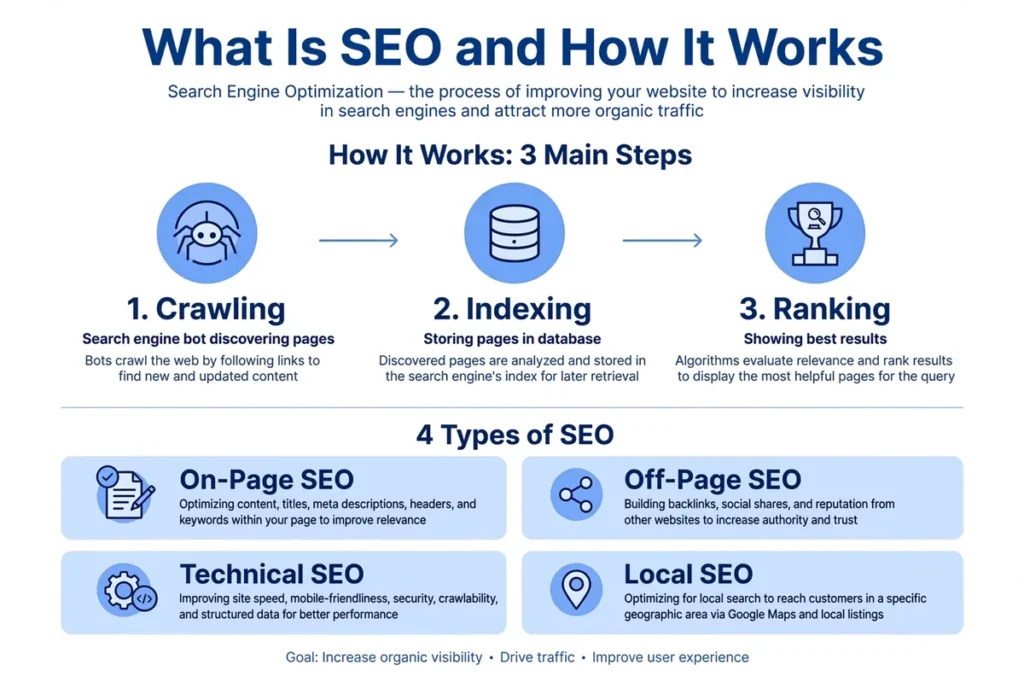
Search engines perform three primary tasks to deliver search results in milliseconds.
- Crawling: Automated software programs called spiders or bots scan the internet continuously. They follow links from one web page to another to discover new and updated content.
- Indexing: Once a bot finds a page, it analyzes the content, images, and structure. It then stores this data in a massive database catalog called an index.
- Ranking: When a user types a query, the search engine scans its index. It uses complex algorithms to select and order the most helpful, relevant pages.
Search engines evaluate over 200 factors to decide which page earns the top position.
Core Factors Behind What Is SEO and How It Works Today
Search engine algorithms evaluate specific signals to measure page quality and user satisfaction.
On-Page SEO Foundations
On-page optimization focuses on elements you directly control on your web pages. This includes creating helpful content that directly answers what the user wants to find.
Structuring your pages with logical headings, title tags, meta descriptions, and image text helps search engines read your page context clearly.
Technical SEO and Site Performance
Technical search engine optimization ensures search engine spiders can access and process your site without friction.
Fast loading speeds, mobile-friendly layouts, secure HTTPS encryption, and clean URL structures form the baseline for strong technical health.
Off-Page SEO and Building Authority
Off-page optimization happens outside your website. The most critical factor is earning high-quality backlinks from other respected websites in your industry.
Think of each backlink as a vote of confidence. When authority sites link to you, search engines view your site as trustworthy.
Understanding What Is SEO and How It Works for Voice Search
Voice search queries are typically longer and phrased as natural conversational questions.
People speaking into phones or smart speakers ask direct questions like “where is the nearest coffee shop” instead of typing short keyword fragments. Optimizing for conversational phrases helps capture these voice-driven queries.
The Four Pillars of Search Engine Optimization
To build long-term traffic, you need to balance all aspects of optimization across your site.
- Technical SEO: Site speed, mobile responsiveness, XML sitemaps, and indexing structure.
- On-Page SEO: Content quality, keyword placement, head tags, and internal linking structure.
- Off-Page SEO: Backlink acquisition, brand mentions, social signals, and digital outreach.
- Local SEO: Google Business Profile optimization, local citations, and geo-targeted landing pages.
You can learn more by exploring the 4 types of SEO to see how each pillar contributes to overall search performance.
Traditional Search vs AI Engine Optimization (GEO & AEO)
Search is changing rapidly with the rise of AI tools like ChatGPT, Gemini, Perplexity, and Google AI Overviews.
Traditional search engines display a list of clickable web links. Modern AI engines synthesize content across multiple pages to answer questions directly inside the chat interface.
To rank in AI-generated answers, your content must offer clear definitions, direct answers, cited facts, and structured data tables. Integrating AI search vs traditional SEO principles ensures your website remains visible across both standard engines and modern AI tools.
[Image Placeholder]
ALT: Comparison chart explaining What Is SEO and How It Works across traditional and AI platforms
Comparison: Search Engines vs AI Answer Engines
| Metric | Traditional Search Engines (Google, Bing) | AI Answer Engines (ChatGPT, Gemini, Perplexity) |
| Primary Goal | Display a ranked list of relevant web links | Deliver direct synthesized answers instantly |
| User Action | Click links to read full pages | Read summaries directly inside the interface |
| Key Ranking Signals | Backlinks, keywords, page experience | Entity clarity, brand authority, direct facts |
| Content Format | Articles, landing pages, blog posts | Structured definitions, bullet points, concise tables |
| Traffic Source | Direct organic clicks to website | Cited brand recommendations and source links |
7-Step SEO Implementation Checklist
Follow this practical sequence to optimize any page on your website effectively.
- Find Target Keywords: Research words and phrases your ideal customers type into search boxes.
- Analyze Search Intent: Look at top-ranking pages to see if users want a guide, product page, or tool.
- Write Helpful Content: Create clear content that solves the reader’s problem completely.
- Optimize On-Page Tags: Place your primary keyword in the title, H1, intro paragraph, and URL slug. Refer to a complete on-page SEO checklist during editing.
- Format for Readability: Break text into short paragraphs, clear headings, bulleted lists, and tables.
- Add Internal Links: Link relevant pages on your site together using descriptive anchor text.
- Build Quality Backlinks: Reach out to industry publications, partners, and blogs to earn links.
Expert Strategies to Rank Faster
These practical strategies have proven effective across multiple client campaigns.
- Target Long-Tail Keywords First: Broader topics are highly competitive. Specific multi-word search phrases carry higher conversion intent and are easier to rank for quickly.
- Refresh Old Content: Updating outdated information, fixing broken links, and adding fresh examples can boost rankings on existing pages within days.
- Focus on User Engagement: Keep readers on your page by matching search intent instantly. High bounce rates signal to search engines that your page did not satisfy the user.
- Answer Questions Direct: Place short 40-word summaries directly under major subheadings to target featured snippets and AI answers.
Common SEO Mistakes to Avoid
Avoid these frequent mistakes that hinder performance in search engine results.
- Keyword Stuffing: Repeating your target word unnaturally hurts readability and triggers search engine penalties.
- Ignoring Mobile Users: Over 60% of searches happen on mobile devices. Sites that perform poorly on phones lose ranking priority.
- Slow Page Speed: Users leave websites that take longer than three seconds to load. Compress images and clean up code to maintain speed.
- Duplicate Content: Publishing identical text across multiple URLs confuses search crawlers and dilutes ranking signals.
Frequently Asked Questions
What is SEO in simple terms?
SEO stands for Search Engine Optimization. It is the practice of improving your website structure and content so search engines like Google can find your pages and display them near the top of organic search results for free.
How does SEO work for beginners?
SEO works by organizing web pages to match what users search for online. Beginners focus on targeting clear keywords, creating informative content, building fast mobile-friendly pages, and acquiring links from other reputable websites to build online authority.
Is SEO worth it for small businesses?
Yes, SEO is one of the most cost-effective long-term digital marketing strategies. It brings consistent target audience traffic to your business without requiring recurring ad spend for every user click.
How long does SEO take to show results?
Most new websites begin seeing noticeable SEO results within 3 to 6 months. Timelines depend on site age, domain authority, keyword competition, content quality, and consistent technical updates.
What is the difference between SEO and SEM?
SEO focuses on earning traffic through organic, non-paid search engine listings. Search Engine Marketing (SEM) includes both organic SEO and paid search engine advertising strategies, such as Google Pay-Per-Click ads.
Summary
Mastering what Is SEO and how it works requires consistent effort across content creation, technical improvements, and link building. Focus on serving your visitors with helpful answers, maintaining a clean site structure, and building domain authority over time. Start implementing these steps today to secure sustainable organic growth.