Ranking on Google requires more than dropping keywords into a blog post. Search engines now evaluate content using advanced artificial intelligence models, entity graphs, and direct answer engines like Perplexity and ChatGPT Search.
To maintain top rankings, your content must satisfy both human readers and AI crawlers.
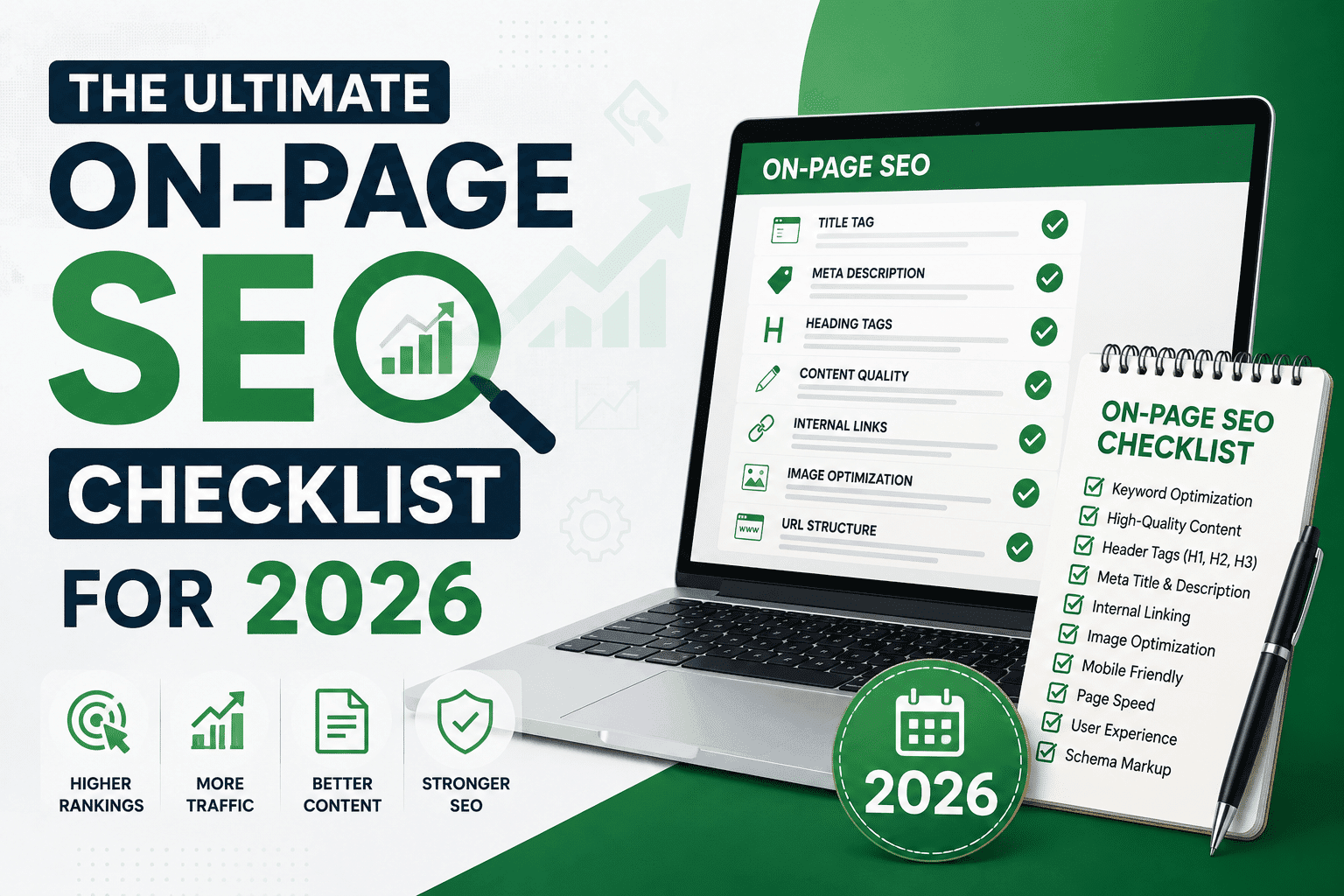
This on-page seo checklist 2026 gives you a step-by-step framework to optimize your web pages, boost organic visibility, and capture traffic from AI Overviews.
What Is On-Page SEO in 2026?
On-page SEO is the process of optimizing individual web page elements to rank higher in search engines and earn relevant organic traffic. It includes optimizing your visible content, HTML source code, meta tags, internal links, and underlying document structure.
+-------------------------------------------------------------------+
|                        ON-PAGE SEO IN 2026                        |
+-------------------------------------------------------------------+
|  1. Semantic Intent        2. Entity Optimization                 |
|  3. Meta & Title Tags      4. Direct Answer Blocks (AEO)          |
|  5. Structured Schema      6. User Experience & Core Web Vitals   |
+-------------------------------------------------------------------+
While off-page SEO deals with backlinks and external trust, on-page SEO gives you complete control over how search engines understand and index your content.
Why Traditional On-Page SEO Has Evolved
Search engines no longer rely on simple word frequency or exact-match keyword strings.
Google uses sophisticated systems like RankBrain, Gemini, and Retrieval-Augmented Generation (RAG) to understand the deeper context of a page.
Search Engine Processing Pipeline (2026)

  [User Search Query]
          |
          v
  [Intent & Entity Extraction]
          |
          v
  [Information Gain & E-E-A-T Analysis]
          |
          v
  [AI Overview / Direct Answer Synthesis]
To rank today, your page must deliver high Information Gain—meaning it provides unique insights, fresh data, or practical advice that competitors lack. To understand how conversational engines evaluate these signals, explore our detailed breakdown of AI search vs traditional SEO.
The Complete On-Page SEO Checklist for 2026
Here is your master checklist for optimizing every page on your website.
1. Title Tags and Meta Descriptions
- [ ] Place your focus keyword near the beginning of your title tag.
- [ ] Keep title length under 60 characters to prevent truncation on mobile screens.
- [ ] Write a compelling meta description under 160 characters with a clear call to action.
- [ ] Include primary entities and natural secondary terms inside the meta description.
2. URL Structure and Permalinks
- [ ] Keep URLs short, descriptive, and clean.
- [ ] Include your primary keyword in the URL slug.
- [ ] Use hyphens to separate words instead of underscores.
- [ ] Avoid using unnecessary numbers, dates, or category parameters in the permalink.
3. Heading Hierarchy (H1, H2, H3)
- [ ] Use only one H1 tag per page, containing your primary keyword.
- [ ] Structure sub-sections logically using sequential H2 and H3 tags.
- [ ] Write H2 headings as natural, conversational questions to capture voice search queries.
4. Content Optimization & Information Gain
- [ ] Include your primary keyword within the first 100 words of your body text.
- [ ] Maintain a natural keyword density between 0.8% and 1.5%.
- [ ] Provide original stats, expert quotes, or personal case studies to maximize information gain.
- [ ] Keep paragraphs short (1 to 3 sentences) for effortless scanning.
[Image Placeholder]
ALT text: On-page seo checklist 2026 diagram illustrating content layout and heading structure
Step-by-Step On-Page SEO Execution Guide
Follow this logical sequence whenever you publish or update a page.
1.Map Search Intent and Core Entities:Step 1: Keyword & Entity Mapping.
Analyze top-ranking competitors to identify primary entities, related LSI terms, and user intent. Map these terms directly to your target headings before writing.
2.Draft Content Using the Inverted Pyramid Method:Step 2: Content Structuring.
Place direct answers immediately below your main sub-headings (40 to 60 words). Follow up with detailed explanations, tables, and bullet points.
3.Configure Meta Tags and Schema Markup:Step 3: Technical HTML Optimization.
Add JSON-LD structured data for Article, FAQ, or Product schemas. Verify that title tags, canonical URLs, and image ALT attributes are fully optimized.
4.Connect Internal Pages and Test Performance:Step 4: Internal Linking & UX Review.
Add relevant internal links to related guides. Ensure your page loads quickly and passes Core Web Vitals checks on mobile devices.
Critical On-Page SEO Factors: 2024 vs 2026
On-page optimization strategies have shifted significantly over the past two years.
| Optimization Vector | On-Page SEO Factors in 2024 | On-Page SEO Checklist 2026 Standard |
| Keyword Strategy | Exact-match keyword placement | Semantic entity clustering & topic coverage |
| Content Depth | High word count & long introductions | Direct answers, high information gain, & zero fluff |
| Search Target | Page 1 SERP blue links | AI Overviews, ChatGPT Search, & Perplexity citations |
| Structured Data | Basic Schema markup | Full JSON-LD entity graphs (sameAs, about, mentions) |
| User Signals | Basic page speed & bounce rates | Core Web Vitals, interaction to next paint (INP), & E-E-A-T |
For a broader look at technical foundation requirements, check out our technical SEO audit checklist.
Schema Markup and Semantic Entity Optimization
Schema markup helps search engines process your page content with complete accuracy.
By adding structured code, you make it easy for AI models to extract direct answers and attribute them to your brand.
JSON
{
  "@context": "https://schema.org",
  "@type": "Article",
  "headline": "On-Page SEO Checklist 2026: 10 Actionable Steps to Rank #1",
  "description": "Master search rankings with this proven on-page seo checklist 2026. Optimize for Google AI Overviews and Core Web Vitals.",
  "author": {
    "@type": "Organization",
    "name": "Web Vision Expert"
  },
  "mainEntityOfPage": {
    "@type": "WebPage",
    "@id": "https://webvisionexpert.com/on-page-seo-checklist-2026/"
  }
}
Learn how to implement structured data step-by-step by reading our complete schema markup guide.
Common On-Page SEO Mistakes to Avoid
Even seasoned marketers run into on-page optimization errors. Avoid these four common traps:
1. Keyword Stuffing
Repeating your target phrase artificially harms your rankings. Always prioritize natural language and readability over strict keyword percentages.
2. Burying the Direct Answer
AI answer engines scan for quick, authoritative summaries. Placing key answers deep inside long introductory paragraphs makes them hard for search crawlers to find.
3. Thin or Duplicate Content
Publishing generic content generated without human editing lowers your site’s overall quality score. Always add unique insights, original data, or real-world examples.
4. Neglecting Internal Links
Orphan pages—pages with no internal links pointing to them—struggle to rank. Always link relevant articles together to build topical authority across your site.
Frequently Asked Questions
What are the main SEO rules in 2026?
The core SEO rules in 2026 focus on search intent, semantic entity optimization, high information gain, and technical performance. You must deliver direct answers for AI Overviews while proving genuine experience, expertise, authoritativeness, and trustworthiness (E-E-A-T).
How do I complete an on-page SEO optimization step by step?
Start by researching search intent and mapping core entities. Next, write short, clear answers directly under your subheadings. Finally, optimize your meta tags, image ALT text, internal links, and JSON-LD schema markup before publishing.
Is traditional SEO still in demand in 2026?
Yes, SEO remains in high demand. However, it has expanded to include Generative Engine Optimization (GEO) and Answer Engine Optimization (AEO). Businesses still need organic search visibility across traditional SERPs, voice search, and AI discovery tools.
What is the difference between on-page and off-page SEO?
On-page SEO focuses on elements you control directly on your website, such as content structure, meta tags, and internal links. Off-page SEO involves external signals like backlinks, brand mentions, and social trust building.