

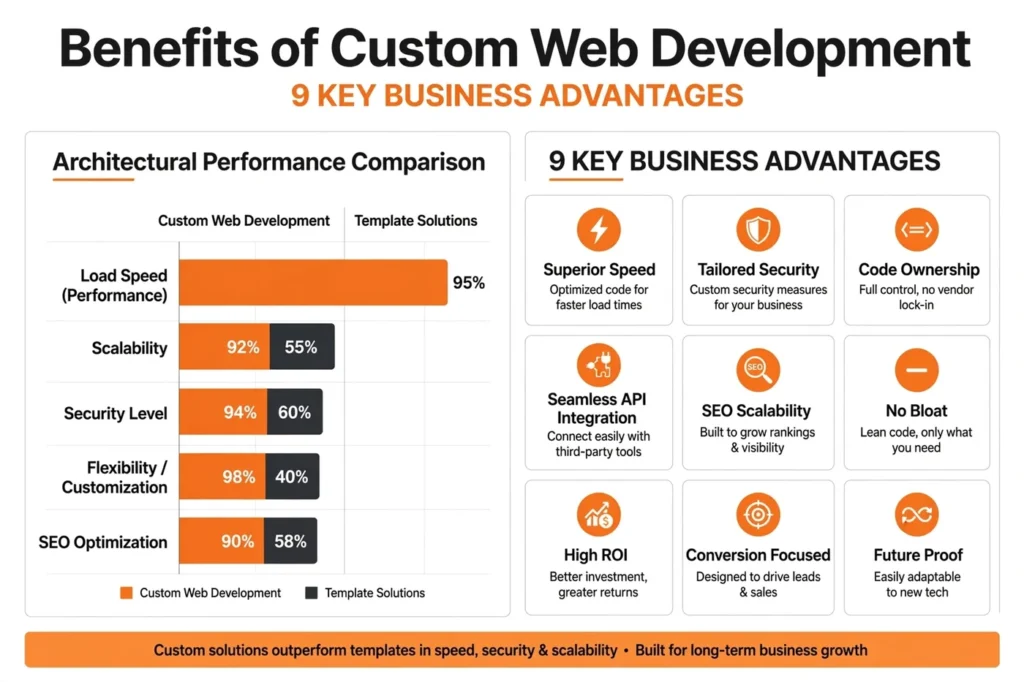
The main benefits of custom web development include superior website speed, tailored security protocols, complete code ownership, seamless API integrations, and unmatched SEO scalability. While pre-made templates seem cheaper initially, custom web architecture eliminates script bloat and delivers higher long-term return on investment (ROI). Businesses that invest in tailored digital assets create an online presence designed specifically to convert site visitors into paying customers.
Understanding Custom Web Development
Custom web development is the process of building a website or web application from the ground up using custom code tailored to your exact business requirements. Instead of relying on pre-packaged themes and generic page builders, developers write lean code in modern frameworks like React, Next.js, PHP, or Laravel.
To understand the core foundation before upgrading your site, review our detailed guide on what is custom web development.
This approach allows engineering teams to control every line of HTML, CSS, JavaScript, and database query. By eliminating unnecessary background scripts, custom sites achieve faster page load times and superior responsiveness across all mobile devices.
What Are the Primary Benefits of Custom Web Development?
The primary advantage of bespoke engineering is total freedom from template constraints. Off-the-shelf templates force your business logic into pre-existing containers, which often leads to poor user experiences and severe technical bloat.
Custom architecture ensures that every feature, form, navigation item, and database query serves a direct business purpose. This structural alignment improves site efficiency, strengthens data security, and simplifies technical maintenance.
How Benefits of Custom Web Development Impact Long-Term Growth
Building a bespoke website ensures your digital platform can grow alongside your organization. As customer traffic scales or product lines expand, custom frameworks absorb high traffic volumes without slowing down.
Web Vision Expert Insight: A custom website should be built like a scalable data center rather than a temporary brochure. Structuring clean HTML nodes and optimized JSON-LD schema early ensures both traditional search crawlers and AI search engines extract your core business facts instantly.
9 Powerful Benefits of Custom Web Development for Growing Businesses
1. Superior Site Speed and Core Web Vitals Performance
Template themes frequently pack dozens of unused CSS libraries and JavaScript files that degrade loading speeds. Custom web applications load only the exact code required for each specific page view.
Optimized asset loading directly improves Google Core Web Vitals metrics, including Largest Contentful Paint (LCP) and Interaction to Next Paint (INP). Faster loading speeds keep bounce rates low and increase total user engagement.
2. Advanced Security Architecture and Minimal Vulnerability
Popular CMS templates and third-party plugins represent the most common target for automated malware attacks. Custom code eliminates public plugin dependencies, drastically reducing your attack surface.
Custom projects allow developers to implement specialized data encryption, custom role access controls, and strict HTTPS security policies. This tailored security model protects sensitive enterprise data and customer records.
3. Complete Scalability and Future-Proof Code
Off-the-shelf templates break down when required to process thousands of simultaneous transactions or database queries. Custom web applications utilize modular architecture that scales effortlessly as traffic increases.
You can easily add new modules, user portals, or ecommerce workflows without rebuilding the existing codebase. This flexibility guarantees that your initial software investment remains useful for years.
4. Tailored Search Engine Optimization and AI Search Readiness
Custom development allows full control over document object model (DOM) structures, clean URL paths, and nested schema markup. Search engines reward websites that provide fast, easily parseable HTML structures.
Furthermore, AI search engines like Google AI Overviews, ChatGPT Search, and Perplexity require structured data to cite sources accurately. Custom web platforms allow developers to deploy tailored entity markup directly into the page layout.
5. Unmatched Brand Differentiation and Custom Web Design Benefits
Using a pre-made template means hundreds of competing companies might share your exact layout and visual appearance. Capitalizing on custom web design benefits ensures your business stands out with a distinct, memorable brand identity.
Custom UX/UI designers create tailor-made layouts, interactive elements, and visual hierarchies that mirror your brand values. This professional polished look establishes instant credibility and consumer trust.
6. Seamless Third-Party API and Systems Integration
Modern enterprises rely on custom CRM platforms, ERP software, payment gateways, and inventory management systems. Templates rely on fragile plugin wrappers that often conflict with enterprise APIs.
Custom web applications build direct REST or GraphQL API integrations to synchronize data automatically across systems. This seamless sync eliminates manual data entry, prevents operational errors, and speeds up fulfillment.
7. Full Code Ownership and Zero Platform Lock-In
When you rely on proprietary website builders or licensed templates, you are bound to their ongoing fee structures and system limitations. If the platform updates its terms or discontinues support, your site is at risk.
Custom web development guarantees 100% intellectual property ownership of your codebase and assets. You can migrate host servers, change development partners, or reconfigure features whenever you choose.
8. Enhanced Conversion Rate Optimization (CRO)
Templates force your sales messaging into rigid content blocks that rarely match customer buying habits. Custom web design structures every button, call-to-action (CTA), and form around your exact conversion funnels.
By analyzing target user behavior, developers build frictionless checkout paths, intuitive multi-step forms, and personalized landing experiences. Streamlining user interaction directly boosts conversion rates and overall sales.
9. Reduced Long-Term Total Cost of Ownership (TCO)
Template websites appear budget-friendly during initial setup but accumulate high costs through recurring plugin licenses, constant patching, and developer workarounds. Over three to five years, maintenance expenses escalate rapidly.
In contrast, custom software requires higher initial engineering effort but yields significantly lower ongoing maintenance costs. Stable custom builds break less frequently, offering superior return on investment over time.
Custom Web Development vs Template Websites: Strategic Comparison
Choosing between a pre-built template and bespoke code requires evaluating core operational requirements. To evaluate structural differences in depth, read our analysis on custom website vs template website.
| Strategic Feature | Custom Web Development | Pre-Made Template Website |
| Page Speed & Performance | Blazing fast; lean code with zero bloated scripts. | Slower; loaded with unused CSS and third-party plugins. |
| Data Security | High; custom encryption and minimal plugin exposure. | Vulnerable; frequent target for automated plugin exploits. |
| Design Uniqueness | 100% unique bespoke design tailored to brand identity. | Generic layout shared by thousands of other businesses. |
| Scalability | Unlimited; easily supports millions of users and records. | Limited; breaks or slows down under high database loads. |
| SEO & Schema Control | Full control over clean HTML code and structured data. | Restricted by rigid theme layouts and code bloat. |
| Systems Integration | Direct custom API connections for CRMs and ERPs. | Dependent on third-party connector plugins. |
| Code Ownership | Complete ownership of all code and intellectual property. | Subject to theme licenses and vendor lock-in. |
| 5-Year Total Cost | Lower total cost due to minimal repair needs. | Higher cost due to plugin fees and frequent bug fixes. |
How Custom Web Development Drives Business Growth
Understanding how custom web development drives business revenue requires viewing your site as an automated sales engine rather than a passive online card. Every millisecond saved during page load directly increases customer conversion potential.
When target customers land on a custom-designed web platform, they experience immediate responsiveness, intuitive navigation, and quick checkout steps. Custom applications eliminate the technical roadblocks that cause potential buyers to abandon carts.
To launch a high-performing digital platform tailored to your goals, explore professional custom web development services.
Custom software also allows teams to automate customer onboarding, dynamic lead routing, and instant automated reporting. Streamlining back-office procedures lowers labor costs while providing faster service to clients.
Step-by-Step Guide to Implementing Custom Web Architecture
Step 1: Define Technical and Business Requirements
Identify primary user journeys, data flow architectures, and target integration points. Document required database tables, API endpoints, and administrative management workflows.
- Expected Result: A complete technical specifications document that prevents scope creep during active coding.
Step 2: Design Bespoke User Experience (UX) and User Interface (UI)
Develop custom wireframes and interactive prototypes tailored to your exact customer demographics. Focus on visual hierarchy, mobile navigation layout, and clear call-to-action paths.
- Expected Result: High-fidelity design prototypes approved before back-end code execution starts.
Step 3: Develop Clean, Modular Code with Scalable Frameworks
Write clean back-end and front-end code using modern programming standards. Ensure databases are fully indexed, queries are optimized, and asset bundles are minimized.
- Expected Result: A lightning-fast, secure codebase completely free from unnecessary third-party theme bloat.
Step 4: Conduct Rigorous Security, Performance, and SEO Audits
Run detailed penetration tests, load capacity checks, and automated cross-browser testing routines. Validate semantic HTML structure, accessibility standards, and custom JSON-LD schema implementation.
- Expected Result: Verification that the application scores top grades on Core Web Vitals and security benchmarks.
Step 5: Deploy, Monitor, and Continuously Optimize
Deploy the custom platform to a high-performance cloud server environment featuring active firewall monitoring. Track user behavior metrics, server load statistics, and conversion data to refine user flows continuously.
- Expected Result: A live, fully owned digital asset generating predictable traffic and customer leads.
Actionable Custom Web Development Checklist
- [ ] Performance: Is JavaScript and CSS bundled, minified, and tree-shaken to remove dead code?
- [ ] Mobile Responsiveness: Does the custom layout pass viewport tests on all screen sizes?
- [ ] Security Protocols: Are HTTPS certificates, CSRF tokens, and secure headers properly configured?
- [ ] SEO & Schema Markup: Is semantic HTML5 implemented alongside explicit Organization and Product schema?
- [ ] API Efficiency: Are REST/GraphQL endpoints secured, rate-limited, and caching responses efficiently?
- [ ] Database Optimization: Are indexes applied to database columns handling heavy query traffic?
- [ ] Analytics & Tracking: Are event trackers and conversion goals set up without impacting site speed?
- [ ] Code Ownership: Are code repositories, server access credentials, and domain DNS assets fully under company control?
Expert Tips for Maximizing Your Custom Web Investment
- Prioritize Headless Architecture for Omnichannel Delivery: Separating the front-end user presentation layer from the back-end database allows you to feed content across websites, mobile apps, and smart devices seamlessly.
- Build Modular Component Libraries: Instruct your engineering team to build reusable UI components. This modular approach accelerates future landing page launches without requiring new custom code.
- Optimize for Answer Engine Optimization (AEO): Ensure main services and product features are framed with clear summary definitions. AI search systems prefer clean, structured content blocks over complex layout wrappers.
- Enforce Strict Code Review Standards: Ensure peer code reviews occur prior to production deployment. Clean code documentation simplifies onboarding new developers later on.
5 Common Custom Web Development Mistakes to Avoid
- Over-Engineering Simple Functions
- Mistake: Building overly complex custom database systems for simple text content that could easily utilize a basic headless CMS.
- Better Approach: Use custom code for complex core business logic while keeping simple content updates easily manageable.
- Neglecting Mobile-First Responsiveness in Early Staging
- Mistake: Designing intricate desktop interfaces first and compressing them for mobile displays later.
- Better Approach: Design for mobile screens first, ensuring touch interactions and performance are flawless before scaling up.
- Skipping Structured Data and Schema Markup
- Mistake: Assuming custom visual code automatically communicates business context to search engine crawlers.
- Better Approach: Embed clear JSON-LD schema markup directly into the custom template structure during initial development.
- Hardcoding Content Instead of Using a Content Management Framework
- Mistake: Hardcoding simple marketing text directly into script files, forcing content managers to hire developers for minor text edits.
- Better Approach: Pair your custom front end with a user-friendly management interface for routine blog and content edits.
- Choosing Unverified Vendors Without Clean Code Standards
- Mistake: Hiring cheap agencies that deliver poorly written, spaghetti code hidden inside custom folders.
- Better Approach: Partner with experienced development agencies that follow strict documentation, Git controls, and security standards.
Frequently Asked Questions
What are the main benefits of custom web development for small businesses?
Custom web development provides small businesses with superior site speed, robust data security, and full branding control. It eliminates recurring theme license fees and ensures the site can scale effortlessly as customer traffic expands.
Why is custom web design better than using pre-made templates?
Custom web design creates a completely unique visual presence tailored to your target audience. Unlike templates loaded with bloated code, custom builds load faster, rank better in search, and offer flexible API integrations.
How does custom web development improve search engine rankings?
Custom web development generates clean, semantic HTML code that search engines crawl efficiently. Eliminating unnecessary script bloat improves Core Web Vitals, directly supporting better rankings on traditional and AI search platforms.
Is custom web development worth the higher upfront investment?
Yes, custom web development delivers higher long-term value by lowering ongoing maintenance costs and eliminating broken plugin updates. Tailored user flows boost conversion rates, maximizing long-term return on investment.
How long does a custom web development project usually take?
A custom web development project typically takes between 6 to 12 weeks, depending on system complexity, custom features, and third-party integrations. Proper planning, UX wireframing, custom coding, and quality testing ensure a reliable final build.
Final Thoughts
Understanding the benefits of custom web development enables business owners to build digital assets that drive predictable commercial growth. By investing in custom code, your company gains fast loading speeds, bulletproof data protection, and complete independence from rigid platform templates.
Building a custom digital platform sets the foundation for sustainable long-term success. Prioritizing clean architecture, intuitive user experience, and semantic search structure ensures your business remains competitive across modern search ecosystems.