
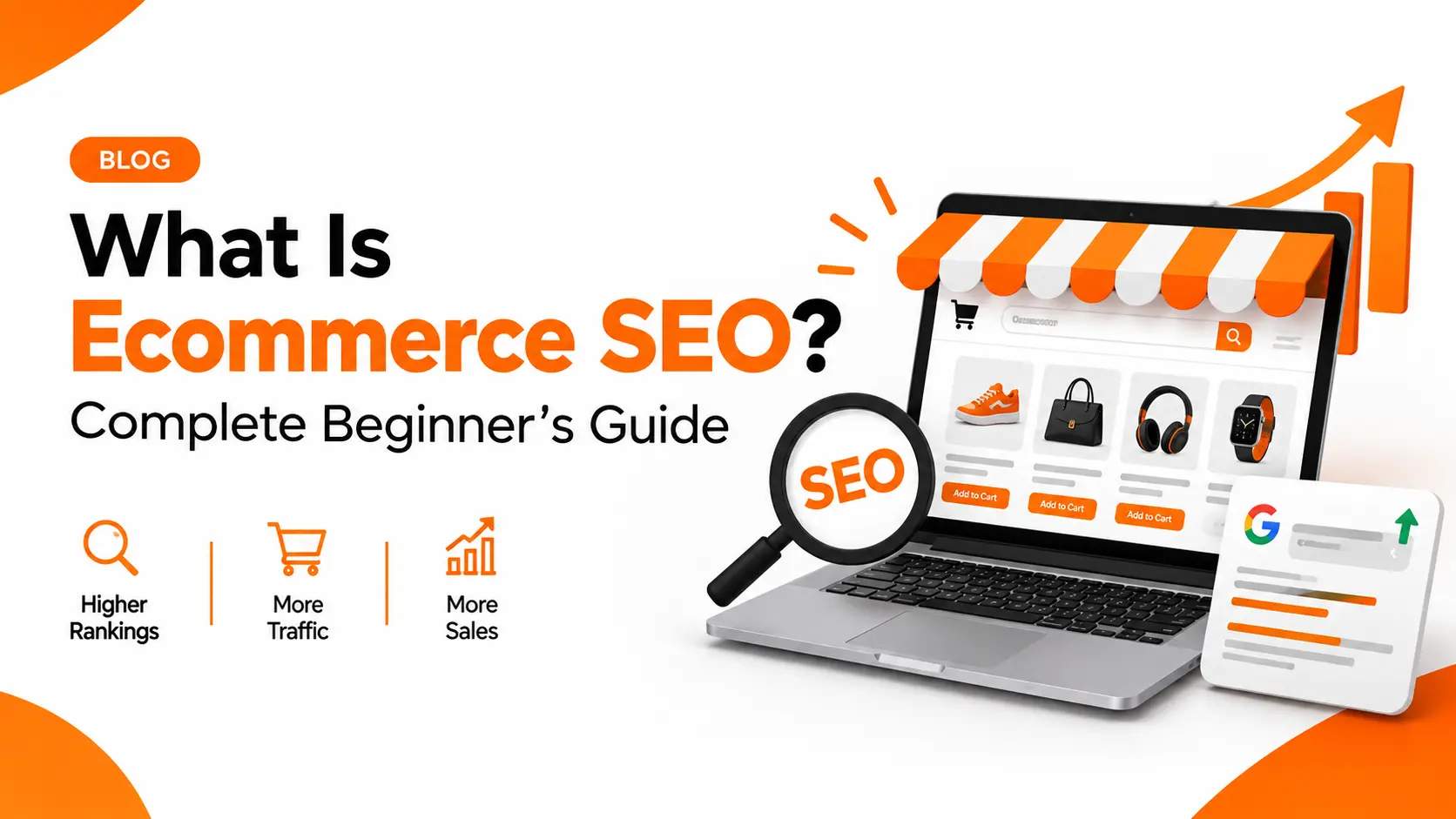
Ecommerce SEO is the process of optimizing an online store so its products, categories, and pages show up in relevant search results. It helps shoppers find your store without you paying for every click.
This guide breaks down what ecommerce SEO actually means, how it works, and how it’s different from regular SEO. You’ll also find real examples, a beginner checklist, and answers to common questions.
What Does Ecommerce SEO Mean, in Simple Words?
Think of your online store as a shop on a busy street with no sign outside.
People walking past have no idea what’s inside. That’s what an unoptimized store looks like to search engines.
Ecommerce SEO puts up that sign, in a language search engines and shoppers both understand.
A shopper looking for a laptop backpack might search in very different ways:
- backpacks
- laptop backpacks
- waterproof laptop backpack
- best backpack for daily commute
- 15 inch anti-theft backpack
Each of these searches expects a different kind of page. A broad term usually needs a category page. A specific product name needs a product page. A comparison-style question often needs a guide or blog post.
Ecommerce SEO is one of several types of SEO businesses use — it’s the version built specifically for stores with products, categories, and shopping carts.
How Does Ecommerce SEO Work?
Search engines need to find, understand, and trust your pages before they rank them. Ecommerce SEO is how you make that easier.
It generally works across five layers:
- Keyword research — finding the exact words shoppers use.
- Search intent — matching each keyword to the right type of page.
- On-page optimization — improving titles, content, images, and links.
- Technical SEO — making the site easy to crawl, render, and index.
- Authority and trust — earning backlinks, reviews, and useful content.
If you’re new to SEO in general, our guide on what SEO is covers the basics before you dive into the ecommerce side.
[Image Placeholder] ALT: ecommerce SEO process showing keyword research, on-page, technical, and authority layers
Ecommerce SEO vs Traditional SEO
The core principles are the same. The complexity is not.
A regular website might have a few dozen important pages — a homepage, some service pages, a blog. An online store can have hundreds or thousands of URLs once you count products, categories, filters, and variants.
That scale changes how you approach almost everything.
| Ecommerce SEO | Traditional SEO | |
|---|---|---|
| Main goal | Sell products | Inform or generate leads |
| Core pages | Product & category pages | Blog posts & service pages |
| Dominant intent | Commercial & transactional | Informational |
| URL volume | Hundreds to millions | Usually a few hundred |
| Common risks | Duplicate products, filter URLs, thin categories | Thin content, weak internal linking |
| Success metric | Revenue, conversions | Traffic, leads, engagement |
Both still depend on the same fundamentals: crawlable pages, useful content, and a site structure search engines can follow.
Why Ecommerce SEO Matters for Online Stores
Paid ads bring traffic fast, but that traffic stops the moment you stop paying.
Organic search keeps working in the background. A well-optimized product page can keep bringing in visitors months after it was published.
Here’s what a solid ecommerce SEO strategy gives you:
- More qualified traffic — people already searching for what you sell.
- Better product discovery — search engines understand which pages matter.
- Lower dependence on ad spend — organic visibility doesn’t switch off.
- A clearer shopping experience — good SEO usually means better navigation too.
- Stronger long-term visibility — rankings tend to compound over time.
Shoppers also search at different stages. Someone typing “what is a waterproof backpack” is learning. Someone typing “buy waterproof backpack under $50” is ready to act. A good ecommerce SEO strategy is built to capture both.
The Main Parts of an Ecommerce SEO Strategy
Keyword Research for Online Stores
Don’t chase search volume alone. Look at intent, competition, and how closely a keyword matches what you actually sell.
Group keywords by type — broad, category-level, commercial, and long-tail — then assign each group to one page. This avoids pages competing against each other for the same search.
Category Page SEO
Category pages often target the broadest, highest-value searches in a store.
A good category page explains what it contains, who it’s for, and what to consider before buying. It should read like something written for a person, not stuffed with repeated keywords.
Search engines can pick up context from your headings, internal links, and the products listed — you don’t need walls of filler text to prove relevance.
Product Page SEO
This is where SEO meets revenue.
A strong product page usually includes a clear, descriptive title, a unique product description, accurate pricing and availability, real specifications, and genuine customer reviews. Our on-page SEO checklist covers this in more detail if you want a page-by-page breakdown.
Avoid copying the manufacturer’s description word for word — duplicate content is one of the most common problems in ecommerce.
Site Structure and Internal Linking
A clear hierarchy helps both shoppers and search engines move through your store:
Homepage → Category → Subcategory → Product
Connect these with descriptive internal links — “shop waterproof backpacks” instead of “click here.” This also helps search engines understand which pages are most important.
Technical SEO for Ecommerce
As a catalog grows, technical issues grow with it: duplicate URLs, redirect chains, thin category pages, and filter-generated links that shouldn’t be indexed at all.
Not every URL your platform creates deserves a place in Google’s index. The goal is to help search engines focus crawl budget on pages that actually matter. Our technical SEO services page goes deeper into this if your store has outgrown basic fixes.
Structured Data for Products
Structured data gives search engines explicit details about a product — price, availability, reviews, and brand.
It can make a page eligible for richer search results, but it isn’t a ranking shortcut. It only describes what’s already on the page correctly. See our schema markup guide for how to set this up properly.
[Image Placeholder] ALT: ecommerce SEO site structure from homepage to category to product page
Understanding Search Intent in Ecommerce
Every search falls into one of four intent groups, and each one usually needs a different type of page.
Informational — “how to choose a backpack for travel.” Best answered by a guide or blog post.
Commercial investigation — “best backpack for daily commuting.” Suited to comparison content or a well-written category page.
Transactional — “buy laptop backpack online.” This belongs on a product or category page, ready to convert.
Navigational — “Nike backpacks” or a specific brand name. The page should match that exact destination.
Mapping each keyword to the right intent — and the right page — is one of the simplest ways to improve ecommerce rankings without touching a single line of code.
Ecommerce SEO by Platform
The platform you build on shapes some of your SEO decisions, but it doesn’t decide your results on its own.
Shopify stores need attention on collection pages, app bloat, and duplicate URLs. Our Shopify SEO guide for Pakistan walks through the platform-specific details.
WooCommerce gives more flexibility, along with more ways to create duplicate content and plugin conflicts. If you’re deciding between the two, this comparison of Shopify SEO vs WooCommerce SEO breaks down the trade-offs.
There’s no single “best” platform for SEO. The best platform is the one you can maintain correctly, with a structure that doesn’t fight against good SEO practices.
Ecommerce SEO and AI Search
AI Overviews, ChatGPT, and Gemini have changed how people discover products, but there’s no separate rulebook for them.
Google has said the same core SEO practices apply to AI-powered search — pages still need to be crawlable, indexable, and genuinely useful. There’s no special schema or hidden trick that gets a page into an AI Overview.
For ecommerce, that means writing clear product and category information, answering real buying questions, and keeping your technical SEO healthy. Our breakdown of how AI search is changing SEO covers this shift in more detail.
Common Ecommerce SEO Mistakes
- Copying manufacturer descriptions across every product.
- Stuffing keywords instead of writing naturally.
- Ignoring category pages while over-focusing on products.
- Letting filters generate thousands of low-value URLs.
- Weak internal linking that buries best-selling products.
- No SEO plan for out-of-stock or discontinued items.
- Slow, heavy pages on mobile.
- Generic content that says nothing a competitor hasn’t already said.
A Simple Ecommerce SEO Checklist for Beginners
- Each important page targets one clear search intent.
- Product titles are specific and descriptive.
- Product descriptions are original, not copied.
- Category pages target real commercial searches.
- Best-selling products are linked internally.
- Navigation is simple and consistent.
- URLs follow a clean, logical structure.
- Canonical tags are set up correctly.
- Product structured data is valid.
- Images are compressed with useful alt text.
- The site works well on mobile.
- Search Console is checked regularly for indexing issues.
[Image Placeholder] ALT: beginner ecommerce SEO checklist for online stores
How Long Does Ecommerce SEO Take?
There’s no fixed timeline.
It depends on your domain’s age and authority, how competitive your niche is, and how many technical issues need fixing first. Some quick technical wins show up within weeks. Competitive commercial keywords can take several months.
What matters more than speed is consistency. Products change, inventory changes, and competitors keep publishing — your SEO needs to keep pace with all of it.
Frequently Asked Questions
What is ecommerce SEO in simple words? Ecommerce SEO is the process of helping an online store appear in search results for product, category, and shopping-related searches. It covers everything from keyword research to technical fixes so shoppers can find your store organically.
Is ecommerce SEO different from regular SEO? The core principles are the same, but ecommerce sites deal with far more pages, product variants, and transactional intent. That extra scale and complexity is what sets it apart.
Do product descriptions really affect SEO? Yes. Unique, useful descriptions help search engines understand the product and give shoppers the details they need to buy. Copied manufacturer text usually hurts more than it helps.
Is Shopify or WooCommerce better for SEO? Both can perform well when properly structured. The right choice depends on your catalog size, technical resources, and how much control you need over the site.
Does ecommerce SEO still work with AI Overviews? Yes. Google says the same foundational SEO practices apply to AI-powered search — there’s no separate set of rules just for AI Overviews or AI Mode.
Can a small store compete with bigger ecommerce sites in search? Yes, especially in specific, long-tail searches where big stores often have weaker, thinner content. A smaller catalog with well-optimized pages can outrank a much larger, poorly structured one.
Final Thoughts
Ecommerce SEO isn’t about repeating the same keyword on every page.
It’s about making your store easy to understand — for search engines and for shoppers. Clear categories, honest product content, a sensible site structure, and a few solid technical habits go a long way.
If you’d rather have this handled for you, our ecommerce SEO services page explains how we approach strategy, technical fixes, and content for growing stores.