
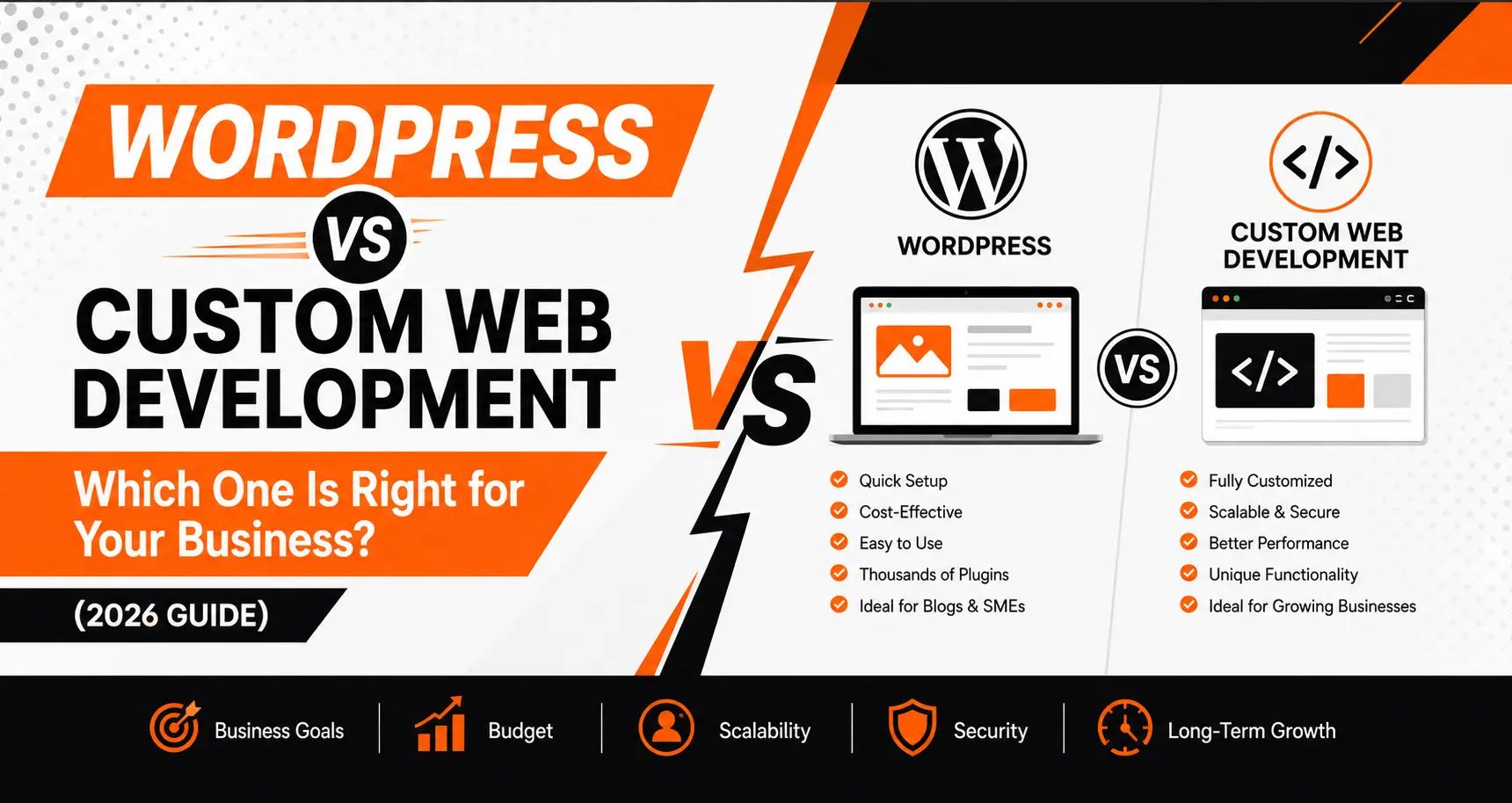
If you’re planning to build a new website, chances are this question has crossed your mind: should I use WordPress, or go with custom web development?
This isn’t just a technical decision — it directly affects your budget, launch timeline, and long-term growth. Many clients ask us exactly this: “Should we build on WordPress, or get custom code written from scratch?” In this guide, we’ll break down every angle of WordPress vs custom web development — pros and cons, cost, performance, security, and which situation calls for which approach. Let’s dive in.
Choosing a WordPress or Custom Website for Business Growth
When deciding between a wordpress or custom website for business, the choice comes down to your operational goals. A standard business site thrives on WordPress, but if your business requires unique workflows, automated customer portals, or proprietary features, a custom setup becomes essential.
What Is WordPress?
WordPress is the world’s most popular Content Management System (CMS), powering over 40% of all websites on the internet. It’s open-source, meaning the core software is free, and you can design a website using drag-and-drop page builders like Elementor without needing heavy coding knowledge.
For small businesses, blogs, portfolios, and mid-size e-commerce stores, WordPress is a fast and cost-effective solution. Thanks to themes and plugins, adding new features is also fairly simple — whether that’s a contact form, a booking system, or an SEO plugin like Rank Math.
What Is Custom Web Development?
Custom web development means your website is built from the ground up — or on a framework like Laravel, React, or Node.js — specifically around your business requirements. There’s no pre-built theme or generic plugin involved; every feature and every piece of functionality is designed to match your exact workflow.
This approach works best for businesses that need unique functionality — like complex booking systems, custom dashboards, or third-party API integrations that standard plugins simply can’t handle.
WordPress vs Custom Code Development: Key Differences
| Factor | WordPress | Custom Development |
|---|---|---|
| Setup Time | Can go live in days | Can take weeks to months |
| Initial Cost | Lower (hosting + theme + plugins) | Higher (developer hours involved) |
| Flexibility | Plugin-dependent | Unlimited — build whatever you need |
| Maintenance | Requires regular updates | Depends on your codebase |
| Scalability | Good up to a point, then gets complex | Designed to scale with your business |
| SEO Control | Good, via plugins | Full control down to the code level |
This table gives you the basic difference between WordPress development and web development, but the real decision depends on your specific business goals.
WordPress vs Custom Web Development: Cost Comparison
This is the most commonly asked question, so let’s address it directly.
WordPress cost:
- Domain + hosting (shared hosting from providers like Hostinger) — plenty of affordable options, starting from a modest budget
- Premium theme (if needed)
- Plugins (some free, some paid)
- Overall, a professional WordPress website can launch on a relatively small budget
Custom development cost:
- Higher cost due to developer/agency hours
- Every feature needs to be designed and coded individually
- But long-term, if your business grows, a custom solution avoids unnecessary plugin costs and limitations
If your budget is tight and you need a fast launch, WordPress’s cost advantage is clear. But if your project is complex — like a large-scale e-commerce platform or a SaaS product — custom development’s upfront cost becomes an investment, not just an expense.
Performance and Speed
WordPress websites, if not optimized properly (too many heavy plugins, unoptimized images, or poor hosting), can become slow. But with good hosting (companies like Hostinger offer performance-focused hosting plans), caching plugins, and clean coding practices, WordPress can run just as fast.
Custom-built websites are usually leaner because they only contain the code that’s actually necessary — no unnecessary bloat. So if speed is a top priority and budget allows, custom development has a natural performance edge.
Security Considerations
One downside of WordPress’s popularity is that it becomes a common target for hackers — simply because so many websites use it. Regular core, theme, and plugin updates are essential for security.
Custom-built websites have a smaller attack surface since there are no generic, widely known vulnerabilities that come with third-party plugins. But that doesn’t mean custom sites are automatically secure — proper coding practices, regular audits, and secure hosting are equally important in both approaches.
Scalability: What Happens When Your Business Grows?
This is a factor that’s often overlooked early on but matters a lot later.
WordPress can scale for small to medium businesses, but when traffic or functionality requirements become very complex — like high-volume e-commerce, custom user dashboards, or multiple system integrations — the combination of plugins can become fragile, and performance issues can start creeping in.
Custom development provides a more solid foundation in this scenario because the architecture is designed with scalability in mind from the start.
SEO: WordPress vs Custom Website
Good SEO is achievable on both platforms, but the approach differs.
On WordPress, managing on-page SEO (meta titles, schema, sitemaps) through plugins like Rank Math or Yoast is fairly straightforward — a practical advantage for small to medium businesses.
On custom websites, SEO needs to be implemented manually — but the benefit is full control over technical SEO (page speed, clean code structure, custom schema), which is valuable for large-scale projects.
If you want to check your website’s current SEO performance, whether on WordPress or a custom platform, you can see our approach in detail on our best SEO services in Pakistan page.
When to Use WordPress
Choose WordPress if:
- Your budget is limited, and you need a fast launch
- You need a blog, portfolio, or standard business website
- You want to manage content yourself without relying on a developer
- Your e-commerce needs are covered by tools like WooCommerce
- You update content frequently (blog posts, product listings)
In these situations, the balance of WordPress vs custom web development pros and cons clearly tips toward WordPress.
When to Use Custom Web Development
Choose custom development if:
- You need unique functionality that no plugin can handle
- Your business logic is complex (custom booking systems, multi-vendor platforms, dashboards)
- Long-term performance and scalability are top priorities
- You need third-party APIs or specific integrations
- Security and full code ownership matter to you
In Pakistan, many fintech, logistics, and scaling startups face the custom PHP vs WordPress Pakistan dilemma. While WordPress is perfect for launching quickly, businesses outgrowing standard plugins often migrate to custom PHP frameworks (like Laravel) to handle heavy local payment gateway integrations and custom shipping APIs securely.
Which Decision Should You Make? A Simple Framework
To clear up the confusion surrounding wordpress vs custom development, ask yourself these three simple questions to determine which architecture aligns with your 3-year business roadmap, ask yourself these 3 questions:
- Does my project need unique/complex functionality that standard plugins can’t handle? If yes, go custom.
- Is my budget or timeline tight, and do I need to launch quickly? If yes, go to WordPress.
- Will my business scale significantly in the next 2-3 years? If yes, starting with WordPress and later moving to a hybrid or custom approach is also a valid strategy.
Many successful businesses actually start on WordPress and, as traffic and requirements grow, replace specific modules with custom-built solutions. This “start smart, scale smart” approach is quite practical.
Common Myths About WordPress vs Custom Development
Many business owners fail to make the right decision because of incorrect assumptions. Let’s clear up a few common myths:
Myth 1: “WordPress is only for blogs.” This was true back in 2010, but not anymore. Today, full e-commerce stores via WooCommerce, membership sites, LMS platforms, and even booking systems all run on WordPress. Through custom WordPress development, a combination of plugins and custom code can support almost any business type.
Myth 2: “Custom development is always better.” This is also incorrect. If your business is simple — like a local restaurant or a consultancy — custom development’s extra cost and time will add unnecessary complexity without any real benefit. The right tool is the one that matches your actual requirement, not the one that “sounds more advanced.”
Myth 3: “WordPress websites are always slow.” Slowness is usually caused by bad practices — heavy, unoptimized themes, dozens of unnecessary plugins, and cheap shared hosting. With good hosting (like Hostinger’s performance-focused plans), lightweight themes, and proper caching, WordPress websites can achieve 90+ PageSpeed scores too.
Myth 4: “Custom websites are automatically more secure.” Security depends on coding practices, regular updates, and the hosting environment — not the platform itself. A poorly coded custom website can be just as vulnerable as a poorly maintained WordPress site.
Long-Term Maintenance: Another Important Angle
When people compare WordPress vs custom web development cost, they often only look at the initial development cost — long-term maintenance gets ignored. That mistake can get expensive.
WordPress websites need ongoing maintenance: core updates, plugin updates, theme compatibility checks, and occasional security patches. If you can’t do this yourself, you may need a maintenance retainer — which adds a small recurring monthly cost.
Custom website maintenance works differently. Since there’s no third-party plugin dependency, updates may be less frequent, but whenever you need a change (a new feature, a bug fix), you’ll need a developer’s help — there’s no DIY option like there is with WordPress.
So when planning your long-term budget, calculate not just the launch cost but the maintenance and update cost for the next 2-3 years as well.
Industry-Wise Recommendation: What’s Best for Which Type of Business?
- Local service businesses (salons, clinics, consultancies): WordPress — fast, affordable, easy to manage
- Small to medium e-commerce stores: WordPress + WooCommerce, as long as product catalog and order volume stay manageable
- Large-scale e-commerce or marketplaces: Custom development, or dedicated platforms like Shopify Plus
- Logistics, fintech, or SaaS startups: Custom PHP or modern framework-based (Laravel, Node.js) development, due to the unique business logic involved
- Portfolio websites, agencies, bloggers: WordPress — content management flexibility matters most here
- Enterprise-level platforms with complex integrations: Custom development, for full control and scalability
FAQs: WordPress vs Custom Web Development
Q1: Which is cheaper — WordPress or custom web development? WordPress is usually cheaper upfront since themes and plugins are ready-made. Custom development has a higher upfront cost but can prove more cost-effective long-term for complex projects.
Q2: Is WordPress good enough for large businesses? Yes, if optimized properly — with good hosting, a clean plugin stack, and proper caching. But for extremely complex, high-traffic platforms, custom development is more robust.
Q3: What’s the difference in maintenance between WordPress and a custom website? WordPress needs regular core/plugin/theme updates. Custom website maintenance depends on code quality — updates are still necessary, but the frequency can differ.
Q4: Is hosting (like Hostinger) the same for both options? No. WordPress benefits from WordPress-optimized hosting plans (which companies like Hostinger offer). Custom websites need server configuration matched to their specific tech stack (Node.js, Laravel, etc.).
Q5: Can I start with WordPress and move to custom development later? Absolutely. This is a common and smart strategy — launch fast on WordPress first, then replace or integrate specific complex features with custom-built modules once the need arises.
Final Thoughts
The choice between WordPress and custom web development isn’t a “one size fits all” decision. It depends on your budget, timeline, functionality requirements, and long-term business goals. For small and medium businesses that want a fast, affordable presence, WordPress is a smart choice. But for those who need unique, scalable, and highly custom solutions, custom web development proves to be the better investment.
If you’re unsure which route is right for your business, get in touch with our team for a free consultation — we’ll review your requirements and give you an honest recommendation, whether that’s WordPress or a full custom solution.